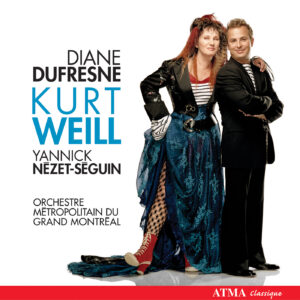
From the beginning of her career in 1965, the provocative Diane Dufresne has been the object of an enduring fascination on the part of audiences everywhere. Events that have marked her rise to fame were the launching of her first album, Tiens-toé ben j’arrive in 1972, her performances at Place des Arts (1975), at the Montreal Forum (1980–1982), and at Montréal’s Olympic Stadium in 1984, where her show Magie rose drew more than 57,000 fans. On the international scene, major concerts in France and Japan also contributed to an ever-growing following. She has figured prominently in virtually all major performance events in Quebec, singing in Clémence Desrochers’ Les Girls, at concerts celebrating the Saint-Jean-Baptiste Fête nationale, at countless festivals, and in the early versions of the rock opera Starmania. Lyricist Luc Plamondon and composer François Cousineau collaborated on the thirty or so titles in her discography. Diane Dufresne has also garnered a total of 37 ADISQ nominations and prizes. Artistic to the core, she has dabbled, with legendary Dufresne daring, in various musical styles, twice presenting symphonic concerts where even Mahler had a place. In the 1990s, the woman known as La Diva or, more respectfully, as La Dufresne, began to write her own material. This activity culminated in a series of concerts at the Musée d’art contemporain in Montréal. Recently she completed with great success her longest tour with the show Liberté conditionnelle. Honoured by France, Canada and Quebec for her “great contribution” towards spreading francophone music across the world, she has made joual rock, from Québec to Paris to Tokyo. Like Edith Piaf and Juliette Gréco before her, she sings what she feels, communicating the very essence of what it is to be alive.